Prompt · grain
Three Speeds
Drag a key across wood at fast, medium and the slowest possible speed. Compose thirty seconds that moves only between those three grains.
Melody asks "which note next?" Texture asks "what does this sound feel like?" Once you start listening for surfaces, layers and distances, a single object can carry a whole piece.
Lead experiment · one sheet of paper
Take a single sheet of printer paper and a phone recorder. Make ten recordings of ten seconds each, changing only one thing at a time: speed, pressure, distance from the microphone, or the surface underneath. Then line them up from smoothest to roughest.
You will have built a texture scale, the same way a painter mixes a range of greys before starting a canvas.
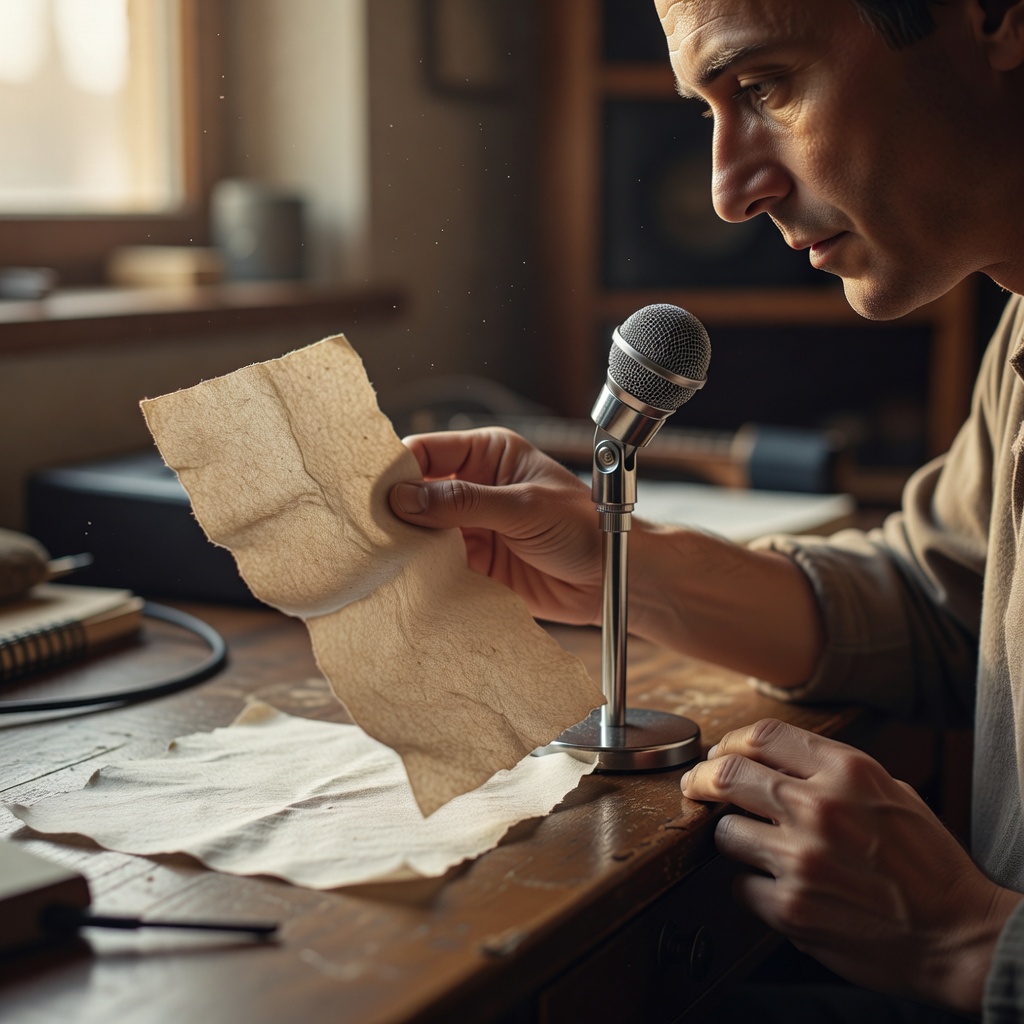
Pierre Schaeffer, who pioneered musique concrète, spent years classifying sounds by their character rather than their source. In his Traité des objets musicaux (1966) he described the "sound object" heard on its own terms. One of his qualities was grain: the fine, rough or smooth micro-texture you hear inside a sustained sound.
To hear grain, slow down. A fast scrape on cardboard is a single noise. A very slow scrape breaks into tiny separate catches. Try the same action at three speeds and you have three distinct grains from one object. Write them down using words that a performer could reproduce: sandy, stuttering, glassy.
Density is how many events happen in a given moment. György Ligeti's orchestral piece Atmosphères (1961) uses dozens of overlapping lines so tightly packed that individual notes disappear into a shimmering mass. You can hear the same effect with a group and dry rice: one person shaking produces audible grains; six people shaking at slightly different speeds produce a continuous hiss.
Try composing only with density. Start with one sound per ten seconds, gradually add players until the room is full, then remove them one by one. No pitch, no rhythm, just crowding and thinning. Most listeners will hear a clear shape.
Every room changes a sound. The composer R. Murray Schafer popularised the idea of the soundscape in The Tuning of the World (1977), and Hildegard Westerkamp turned walking and listening into composition in works such as Kits Beach Soundwalk (1989). Pauline Oliveros recorded the album Deep Listening inside an underground cistern at Fort Worden, Washington, with a reverberation lasting around 45 seconds.
You probably have a bathroom, a stairwell and a wardrobe. Play the same sound in each and record it. The bathroom adds bright reflections, the wardrobe swallows them, and the stairwell adds long tails. Space is an instrument you already own.
Prompt · grain
Drag a key across wood at fast, medium and the slowest possible speed. Compose thirty seconds that moves only between those three grains.
Prompt · density
One to six players with rice jars. A leader raises fingers to show how many play. Silence is a closed fist.
Prompt · space
Record a single hand clap in four rooms. Play them back in order and hear the clap change shape without changing the action.
Prompt · long tones
Éliane Radigue's music unfolds through very slow changes in sustained sound. Hum one note for two minutes and shape only the vowel. Notice how much changes inside one pitch.
Room tone matters more than it seems. Twenty seconds of a quiet kitchen has a hum, a tick and a distant street, which can become the floor beneath a piece. When you are ready to write textures down, the next page shows how to draw them.
Draw the textureAbout cookies Essential cookies keep this site working. Optional ones help us see what is useful. You can change your choice at any time. More about cookies