Conceptual instruction · phasing by hand
Two Clappers, Slowly Apart
Two people clap the same short pattern together. One player very gradually speeds up until they are a full clap ahead, then holds. Listen for the new patterns in the middle.
Generative music is music where you design the process and let the process produce the details. It sounds technical, but its core idea is older than computers and fits on an index card.
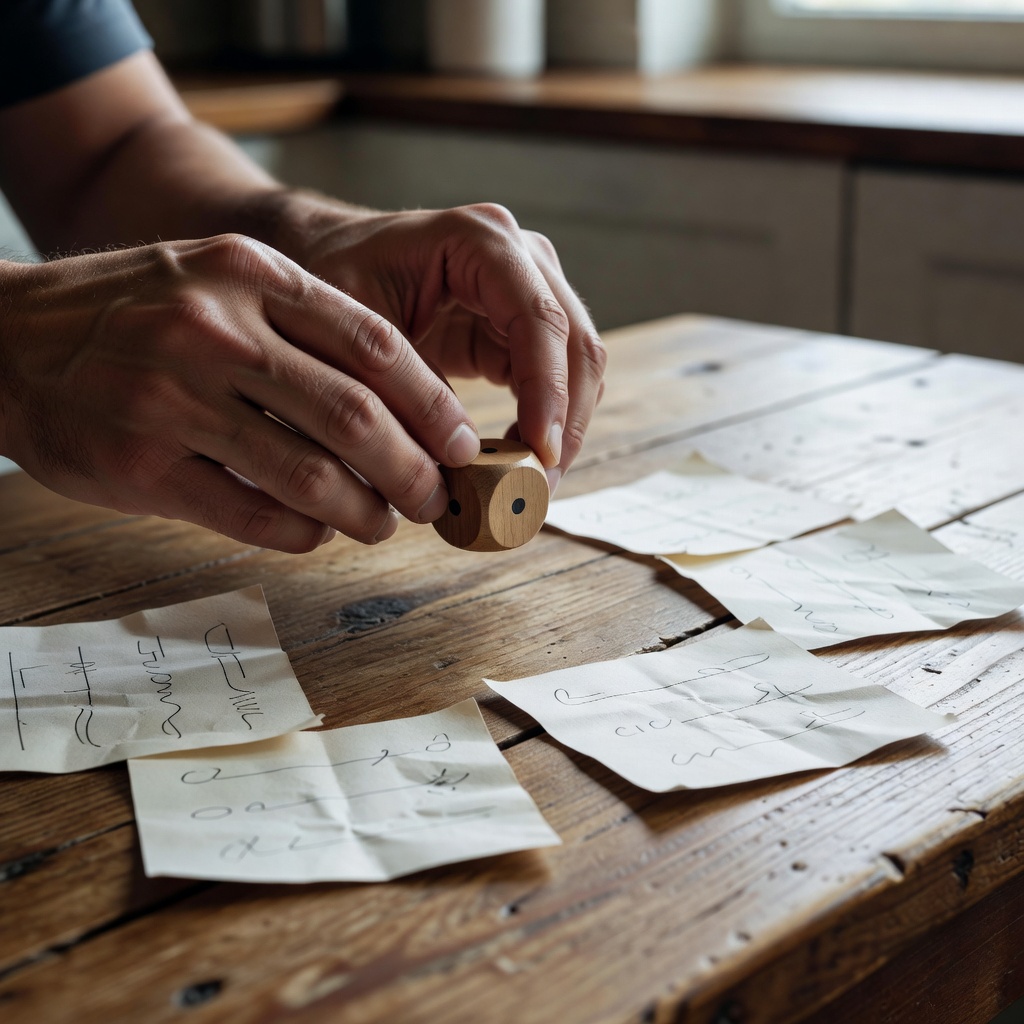
Lead experiment · dice and three objects
The second version will usually feel more connected, because the rule introduces memory. That is the central lesson of rule-based composition: small changes to a system produce large changes in what a listener hears.
John Cage composed Music of Changes (1951) by consulting the I Ching, the ancient Chinese book of divination, using coin tosses to decide pitches, durations and dynamics. His aim was not randomness for its own sake. He wanted to get his personal habits out of the way so that sounds could be heard "as themselves".
You can borrow the method without the philosophy. Use chance to decide the things you always decide the same way. If you always start loud, let a coin choose the opening dynamic. If you always play for exactly a minute, let a card choose the length. Keep the decisions you care about, such as the choice of materials, under your own control.
Steve Reich's It's Gonna Rain (1965) began with two tape loops of the same spoken phrase that drifted slowly out of sync. The listener hears new rhythms emerge that nobody wrote. Terry Riley's In C (1964) gives a group 53 short phrases; each player repeats a phrase as long as they like before moving to the next, so the overlaps are different every time.
Brian Eno built Music for Airports (1978) from tape loops of different lengths. Because the loop lengths did not share a common cycle, the combinations kept shifting. Eno and the painter Peter Schmidt also published Oblique Strategies (1975), a deck of cards with instructions for breaking creative deadlock.
Conceptual instruction · phasing by hand
Two people clap the same short pattern together. One player very gradually speeds up until they are a full clap ahead, then holds. Listen for the new patterns in the middle.
Conceptual instruction · uneven loops
Player one sounds every 3 breaths, player two every 5, player three every 7. The full pattern only repeats after 105 breaths. Perform the first twenty and notice the near-coincidences.
Conceptual instruction · the card deck
Write ten instructions on cards: "Quieter", "Use the floor", "Imitate the last sound", "Stop". Draw one every thirty seconds during an improvisation.
Conceptual instruction · feedback through a room
Inspired by Alvin Lucier's I Am Sitting in a Room (1969): record one sentence, play it back into the room and record it again. Repeat ten times with two phones and hear the room's resonance take over.
Everything above can be done with people, objects and paper. Software can run similar processes faster or for longer, but it changes who is listening and deciding. This site describes concepts; it does not offer or promise any tool that composes for you.
| Aspect | Conceptual instruction (paper, people) | Interactive software |
|---|---|---|
| Who applies the rule | Performers, who can bend it in the moment | The program, exactly as coded |
| Source of variation | Dice, cards, human timing and mistakes | Pseudorandom number generators |
| What you need | Objects, a die, time to rehearse | A device and learning time |
| Real examples | In C, Sonic Meditations, Fluxus event scores | Pure Data by Miller Puckette, SuperCollider, Eno and Peter Chilvers's app Bloom (2008) |
| Best for | Shared listening, group decisions | Very long or very fast processes |
A useful habit Before you open any software, perform your rule by hand once. If it is not interesting slowly, it rarely becomes interesting fast.
Iannis Xenakis applied probability theory to orchestral writing in Metastaseis (1954) and later in his "stochastic" works, showing that mathematical rules can produce dense, physical music. His point for us is practical: a rule is a compositional choice, and you are still responsible for choosing it well.
About cookies Essential cookies keep this site working. Optional ones help us see what is useful. You can change your choice at any time. More about cookies