Draw Something Another Person Can Play
A graphic score is a drawing that asks to be heard. It sits between a picture and an instruction, and its value lies in how much it lets a performer decide.
A Short History of Drawn Music
Morton Feldman's Projection 1 (1950) for solo cello used boxes on a grid to indicate register and timing, leaving the exact pitch to the player. Earle Brown's December 1952 is a single page of horizontal and vertical rectangles that can be read from any direction. Between 1963 and 1967 Cornelius Cardew drew Treatise, 193 pages of lines, circles, numbers and shapes with no key at all, later performed by the Scratch Orchestra he co-founded in London.
Visual expression has pulled the other way too. Wassily Kandinsky described colours as if they were sounds and titled paintings Composition and Improvisation. Cathy Berberian's Stripsody (1966) turned comic-book sound effects into a vocal score. Iannis Xenakis designed the UPIC system so that drawings on a tablet could be turned directly into sound, using it for Mycenae-Alpha (1978).
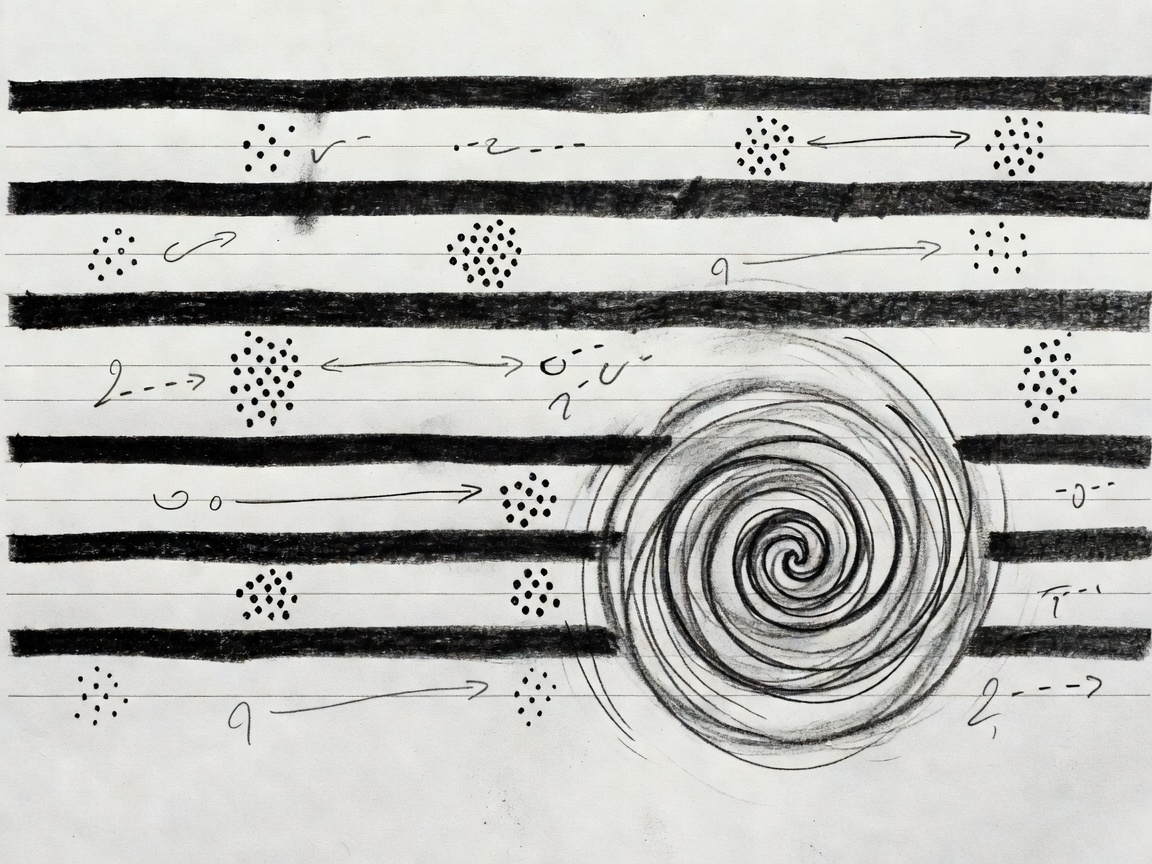
Score annotations
Reading the Page Together
Time passes across the page. Agree before you start how long one page lasts: one minute is a good default.
A sustained sound. The band's thickness suggests loudness or how many players join.
Short, separate sounds. More dots in an area means higher density.
Left undefined on purpose. Each performer decides privately and the group hears the result.
Lead experiment · two players, one page
The Swap Score
- Each person draws a score on a postcard in five minutes: lines, dots, shapes, anything.
- Write a legend with exactly three symbols explained. Everything else stays open.
- Swap cards. Perform each other's score with an object from the materials list.
- The composer listens and writes one sentence: what did the performer hear in my drawing that I did not?
- Paper postcards or index cards
- Marks pencil, charcoal, one coloured pen
- Sound any object, voice or instrument

How Much Should a Score Explain?
Every graphic score makes a choice between control and openness. A detailed legend, saying "a red line is a bowed sound, a dot lasts half a second", produces performances that resemble each other. No legend, as in Treatise, produces performances that differ enormously and reveal how each player thinks.
Neither is better. Decide what you want to hear. If you care about the shape of the piece, specify time and density and free the sounds. If you care about particular sounds, specify materials and free the timing. Write that decision at the top of the page so performers know where their freedom lies.
Expandable Variations
The circular score
Draw on a paper plate. Players start at different points on the rim and travel clockwise. The piece ends when everyone returns to their start.
The map score
Use a printed street map. Main roads are sustained sounds, junctions are accents, parks are silence. Each player follows a different route.
The weather score
Draw what you see from a window for one minute: clouds, birds, rain. Then perform the drawing immediately, before you forget what each mark meant.
Prompt · music to image to music
The Translation Chain
Person one plays thirty seconds. Person two draws it. Person three performs the drawing without having heard the original. Person four draws that. Compare the first and last drawings. What survived?
This chain shows the core relationship between music and visual expression: each translation keeps some qualities, such as shape, density or energy, and loses others, such as pitch or timbre. Knowing which qualities survive helps you choose which to draw.
Share your score idea